
More Insights
See all




%20Might%20Disappear%20%E2%80%93%20and%20What%20to%20Do%20About%20It.png)

185K+
Websites + Marketplaces Tracked
1M+
Merchants Tracked
1.2M+
of Automated Actions Initiated Monthly
2.4B+
of Data Points Tracked
Why do pricing enforcement programs fail — even when the policy is solid? TrackStreet breaks down the 5 rules of modern pricing enforcement, with real-world results and actionable checklists to help brands protect margin and enforce consistently at scale.

Some enforcement programs fail because the policy is too hard to enforce, or lacks real consequences. But for most, this isn’t the real issue. The real issue is that the execution model doesn’t match how marketplaces actually behave.
Many brands rely on numerous signals that are hard to parse or act on, forcing teams into an all-or-nothing choice: ignore violations or trigger consequences they’re unwilling to enforce. SKU-level issues get escalated in large volumes that are hard to manage, merchant-level actions stall under sales pressure, and violations quietly persist.
Add in manual workflows, inconsistent escalation, and internal misalignment, and enforcement becomes reactive and easy to bypass. The end result is noise, price erosion, and a policy that exists on paper but not in practice.
This guide distills TrackStreet’s real-world enforcement experience into practical rules to help brands apply pressure effectively, avoid common missteps, and build programs that actually work at scale.
Enforcement fails when the consequence feels arbitrary.
If the consequence doesn’t match the violation, retailers ignore it, sales teams override it, or leadership loses confidence in the program. Enforcement only works when the signal feels fair, intentional, and unavoidable.
Most brands fall into one of two traps:
This is why proportionality matters. A single mispriced SKU shouldn’t trigger a nuclear response. But repeated violations across a product line shouldn’t be met with polite reminders either. Retailers respond when the impact is real, targeted, and clearly tied to their behavior.
A leading global producer of specialty chemicals and water treatment solutions was struggling with internal misalignment. Account reps, concerned about jeopardizing partner relationships, contacted retailers directly to resolve violations. They expected direct communication would work without needing to escalate.
It didn't. They switched to automated unilateral enforcement notices. Within two weeks, their violating merchant rate dropped over 50%, their violating product rate dropped 80%, and retailer price compliance jumped from 62% to 96%. Compliance rates for Amazon and Walmart improved from the low 50s to near 90%.
One-size-fits-all enforcement is how good programs quietly fail.
Pricing violations don’t all deserve the same response. Some are isolated to a single SKU. Others spread across sizes, colors, or variants. In some cases, the issue isn’t actually the product; it’s the retailer.
When brands only enforce at one level—usually the merchant level—they end up with a false choice: do nothing, or overreact at that single level. Without a way to mix SKU‑, product‑, and merchant‑level action, enforcement stalls and violations persist.
But effective programs match the response to the behavior:
The goal is to send a signal that’s strong enough to change behavior without blowing up the relationship or internal alignment.
A 200-year-old British footwear brand renowned for comfort, quality, and iconic casual styles started with TrackStreet enforcing at the product level. Their teams were spending significant time manipulating data and creating reports at the SKU level – common in footwear and apparel. Transitioning to SKU-level enforcement allowed them to save time and enforce the way their internal teams actually preferred to work.
The brand needed a solution that matched their internal product structure. They partnered with TrackStreet to build SKU-level enforcement and reporting, creating an offering co-designed with exactly the type of brand operating in this space.
If escalation isn’t predictable, it isn’t credible.
Retailers don’t change behavior because of one-off penalties or surprise actions. They change when they understand the ladder — what happens after the first violation, the second, and the third — and know the next step will actually happen.
When escalation is inconsistent or opaque, enforcement loses force. Retailers test boundaries. Internal teams hesitate. Exceptions creep in. Over time, the program becomes symbolic rather than operational.
Strong enforcement programs make escalation boring. The same violation triggers the same response every time, regardless of channel, timing, or account size. Nothing feels personal or arbitrary.
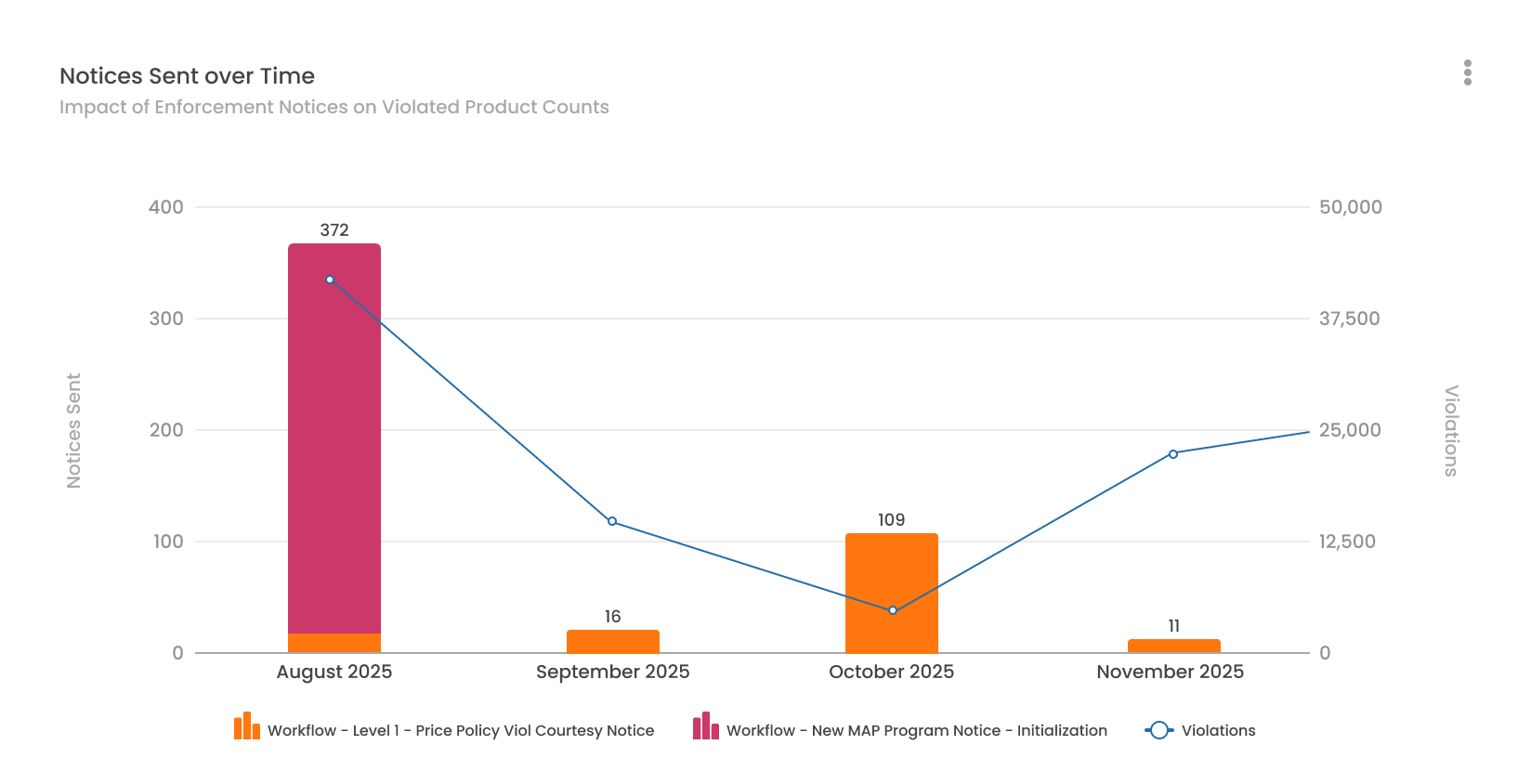
A premier German defense contractor activated enforcement during onboarding, and results were immediate and sustained from September through early November. TrackStreet discovered approximately 27,000 price violations. The company started with a warning letter, which produced a significant drop. After a few weeks of consistent enforcement, violations fell to under 2,000—a 93% reduction.
During a MAP holiday, they paused enforcement notices. The number of violating merchants immediately climbed back up, confirming that sustained pressure drives sustained compliance.

Most enforcement programs fail internally (not externally).
Pricing violations are easy to spot. Acting on them is harder. Sales push back. Marketplace teams worry about numbers. Legal wants caution. Leadership wants exceptions. The result is delay, dilution, and/or inaction.
Retailers notice this. When enforcement decisions stall or get reversed, the signal disappears. Over time, teams stop escalating issues at all because they don’t believe action will follow.
The strongest programs are designed to survive internal pressure. Roles are clear. Thresholds are agreed upfront. Enforcement decisions don’t require re-litigating policy every time a violation occurs. There’s efficiency and speed of delivery.
If enforcement depends on alignment after the violation, it’s already too late.
A high-growth player in the premium, raw-focused segment of the US pet food industry faced internal misalignment on how brand protection impacts revenue. While they maintained visibility into their eCommerce market, enforcement notices were turned off for months. Violations climbed to over 101,000—a 24% violation rate.
After months of internal discussions and working with TrackStreet for strategic guidance, they resumed enforcement. Their price violation count dropped 86%.

If enforcement only works when people remember to do it, it isn’t a system.
Sustainable enforcement is an operating model. Pricing signals, escalation logic, enforcement levels, and reinstatement all work together continuously (not reactively).
Programs break when enforcement lives in spreadsheets, inboxes, or tribal knowledge. Violations get missed. Escalation resets. Decisions vary by retailer, channel, or quarter. Over time, enforcement becomes inconsistent, and retailers learn how to work around it.
The most effective brands treat enforcement like infrastructure. Monitoring runs daily. Escalation follows defined paths. Actions trigger automatically. Reinstatement is clean. Nothing depends on memory, urgency, or heroics.
When enforcement is systematized, it scales – across SKUs, retailers, marketplaces, and seasons – without burning out teams or stalling growth.
A major player in the specialized footcare and athletic accessories market created nearly 70 email templates. Even with a dedicated resource in place, their overly-specific approach required approving pending messages and customizing emails on the fly. Results lagged behind industry peers.
When staff transitioned out, the program collapsed. The system wasn't scalable. Outreach slowed, and the violation rate rapidly increased. The new program lead recognized the problem: they'd built a system that couldn't operate at scale.They're starting over with a proper automated solution—one dashboard focused on MAP enforcement for resale partners, another focused on unauthorized sellers.

These rules, or the other rules that brands set for themselves, don’t usually fail because teams don’t understand them. They fail because most enforcement programs aren’t built to support them at scale or across different enforcement types.
TrackStreet turns best‑practice enforcement into an operational system. Pricing violations are detected continuously across marketplaces and retailers, and each incident follows a clear, policy‑defined path with consequences that can be applied at the merchant, product, or parent product level – without forcing you to choose one level forever
Instead of manual checks, ad‑hoc decisions, and internal friction, teams get a single enforcement engine with automated workflows, evidence‑backed communication, configurable escalation steps, and a consistent end state for repeat offenders such as do‑not‑sell status. Every action is logged, every signal is defensible, and every team – from brand protection to sales to leadership – works from the same data and the same rules, so there’s no need to juggle separate dashboards or switch enforcement modes mid‑conversation.
The result is enforcement that isn’t just theoretically sound, but executable in the real world – protecting margin, reinforcing partner trust, and keeping pricing control intact as your channels scale.
Websites + Marketplaces Tracked
Merchants Tracked
of Automated Actions Initiated Monthly
of Data Points Tracked
